
Dr Xinyuan Ke
BEng, PhD, MIMMM, FHEA
Materials Scientist & Sustainable Construction Specialist

Biography
I am a materials scientist working at the intersection of artificial intelligence, sustainable construction and industrial decarbonisation. My research explores how engineering intelligence can accelerate the discovery of high-performing, low-carbon materials and translate them into scalable, sustainable technologies for the construction industry.
I hold a PhD in Materials Science and Engineering from the University of Sheffield and have held positions as a Prize Fellow and Senior Lecturer at the University of Bath (2018-2026). As Principal Investigator, I have secured and led six research grants worth more than £1 million, spanning intelligent materials design, carbon-negative feedstocks and on-site CO₂ utilisation. My work has been recognised through a QinetiQ research prize and selection among the Women’s Engineering Society’s Top 50 Women in Engineering in 2026.
More recently, I have become particularly interested in using AI-assisted coding to translate my specialised domain knowledge into open, accessible research tools, making advanced materials characterisation and analysis methods easier to use, adapt and share (check DigitalAAM v0.1).
Driven by a passion for sustainability and materials intelligence, I continue to pursue practical, innovative pathways towards a low-carbon built environment.
Digital Materials Design Framework
DigitalAAM — intelligent, data-driven design for maximum resource efficiency.
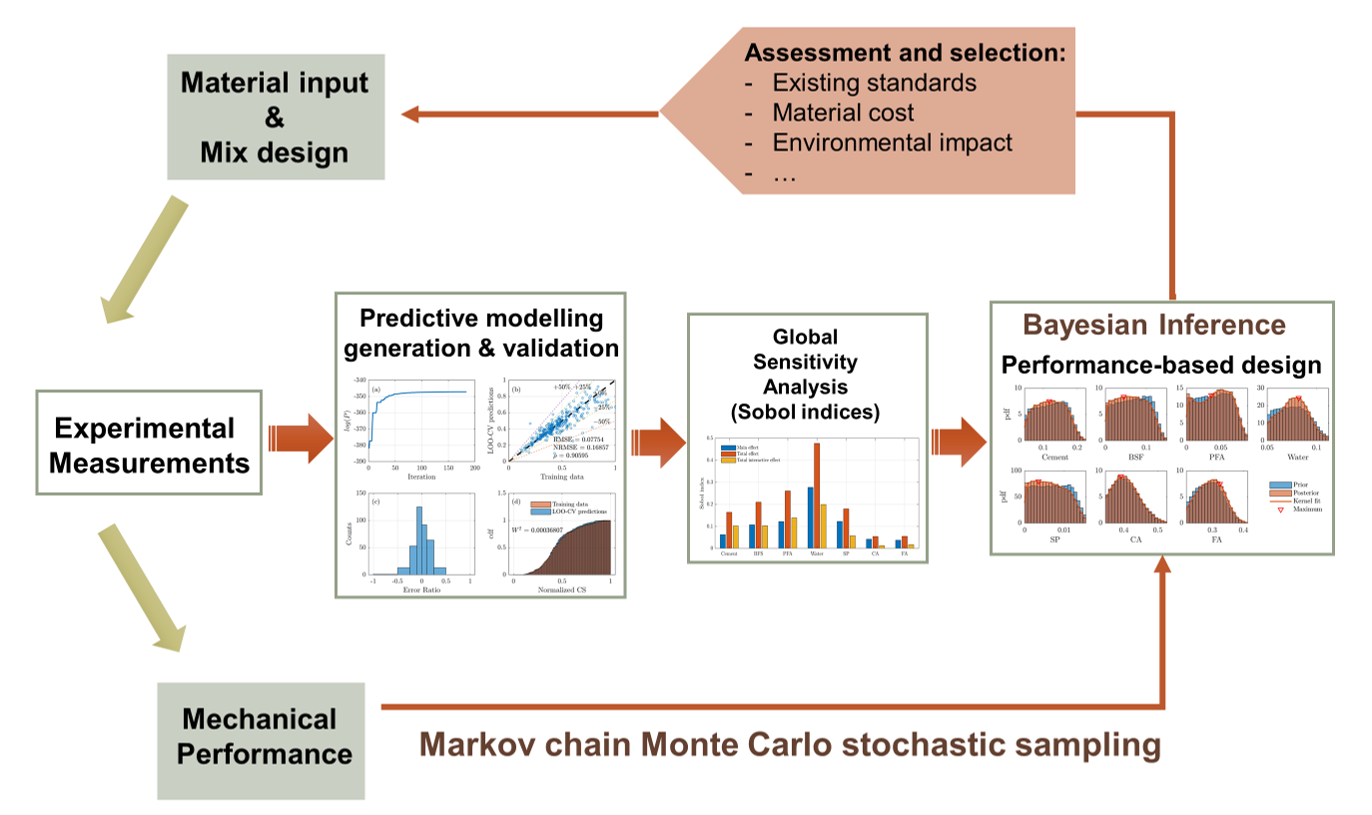
We use machine learning and advanced thermodynamic modelling to rapidly screen thousands of material combinations. This digital approach accurately predicts how low-carbon materials will perform under real-world stresses decades into the future, de-risking green concrete for cautious engineering sectors.
Featured Publications
• Coupling machine learning with thermodynamic modelling to develop a composition-property model for alkali-activated materials
Ke, X. and Duan, Y. (2021) Composites Part B: Engineering, 216. doi: 10.1016/j.compositesb.2021.108842.
• A Bayesian machine learning approach for inverse prediction of high-performance concrete ingredients with targeted performance
Ke, X. and Duan, Y. (2021) Construction and Building Materials, 270. doi: 10.1016/j.conbuildmat.2020.121424.
• Thermodynamic modelling of phase evolution in alkali-activated slag cements exposed to carbon dioxide
Ke, X., Bernal, S.A., Provis, J.L. and Lothenbach, B. (2020) Cement and Concrete Research, 136. doi: 10.1016/j.cemconres.2020.106158.
• Evaluating Machine Learning Models for Predicting the Carbonation Depth in Alkali-Activated Concretes
Ding, B., Ke, X. and McCullen, N. (2026) Springer.

